


The gap between AI and humans
THE GAP BETWEEN AI AND HUMANS
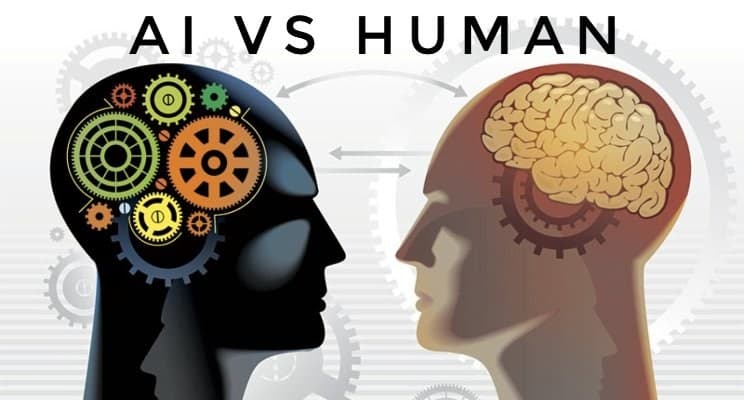
DeepMind's achievements in recent years have been genuine leaps in artificial intelligence. Even so, the ability to play a board game is not cognition. Demis Hassabis's ambition at DeepMind for a general AI — an AI able to turn information into knowledge — is a grand story indeed.
But to this day the cognitive ability of the strongest AI does not compare with that of a two-year-old child, or even a one-year-old. Every free mind possesses the capacity for self-awareness: from experience it forms notions, and from notions named by language it forms knowledge. The characteristic way a mind uses its knowledge forms morality and character — the marks of a free mind.
For example, how could a robot display a sense of humour like TARS in Christopher Nolan's film *Interstellar*?
If you were the AI programmer, how would you code that?
Humour itself is a trait formed on a foundation of knowledge. To be funny is to take different concepts and join them, from unusual angles, so as to arrive unexpectedly at a related concept; done well, that can make people laugh.
So in general, when an AI can be configured for a level of humour — even config-and-run, configured once at start-up and used indefinitely — that will still be an interesting piece of science fiction, because the AI would have to genuinely grasp many semantic facets of a concept. It would be a real mind, not merely a chatbot working over a finite set of named language structures.
So what is that gap, really? And how could it be closed?
The gap may lie in the internal structure of each neuron, natural rather than simulated; it may lie in information that is alive inside a natural structure rather than merely the static states of a machine; it may lie in natural language, which names and describes every concept from the concrete to the abstract; it may lie in the mechanisms of emotion and intuition, which have never been simulated at all.
We believe cognitive science, a young field growing fast, will answer those questions before long.
Until they are answered, there is no need to work ourselves up over the threat of the chatbot Sophia destroying humanity. Sophia — a citizen of Saudi Arabia — is only talking to a script; there is nothing frightening about it.
At STECH we are not afraid that AI will destroy humanity. We concentrate instead on useful applications of AI, such as recognition problems and problems of finding the distinguishing features of objects and phenomena. These are hard problems that consume a lot of resources; you do not get a useful application simply by deploying open source code without a scientific grounding in the field.
- source: dev@stech.vn -